
Spirometry
Lung Function Testing When Breathing Feels Hard
Spirometry in Oakhurst, Toms River, Old Bridge, and Eatontown, NJ for persistent cough, wheezing, and unexplained shortness of breath.
Family First Urgent Care performs spirometry for patients in Oakhurst, Toms River, Old Bridge, and Eatontown, NJ who need objective measurement of lung capacity and airflow when breathing feels restricted, coughing lingers past three weeks, or wheezing interrupts sleep and exercise. You blow forcefully into a mouthpiece connected to a computerized sensor that graphs how much air you move and how quickly it leaves your lungs, producing numbers that distinguish asthma from chronic obstructive pulmonary disease, restrictive lung conditions, or deconditioning that mimics respiratory disease.
The test measures forced vital capacity, the total volume you can exhale after a full inhale, and forced expiratory volume in one second, the speed at which air exits. Lower-than-predicted ratios indicate obstruction, while proportional reductions suggest restriction. If you already use an inhaler, we may repeat the test fifteen minutes after bronchodilator administration to see whether airflow improves, which helps confirm reversible bronchoconstriction typical of asthma rather than fixed narrowing seen in emphysema.
Walk in if you need baseline lung function data, diagnostic clarity, or documentation for disability or work restrictions.
What to Expect During the Breathing Test
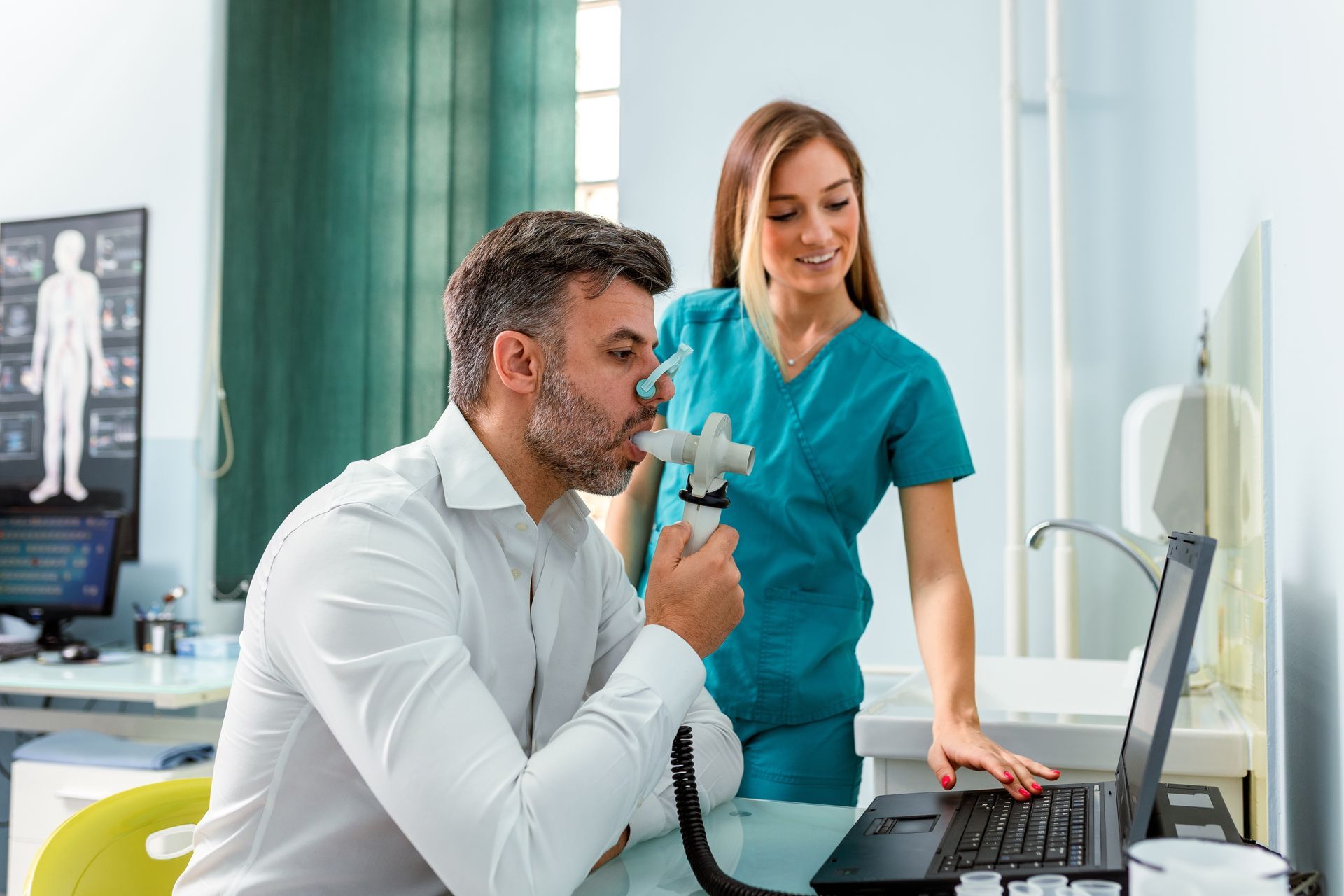
You sit upright, place a disposable mouthpiece between your lips, and wear a nose clip to prevent air leakage. When prompted, you inhale as deeply as possible, then exhale as hard and fast as you can until your lungs feel completely empty. Most patients repeat the maneuver three times to ensure reproducible results. The machine graphs each effort in real time, and your provider selects the best trial for interpretation based on peak flow and effort duration.
After testing, you review a printout showing your actual values compared to predicted norms adjusted for age, height, sex, and ethnicity. If your FEV1/FVC ratio falls below seventy percent and improves after albuterol, your provider discusses initiating or adjusting controller medications. If values remain low without reversibility, you may need chest imaging, referral to pulmonology, or evaluation for occupational exposures and interstitial lung disease.
This test does not measure oxygen saturation, diagnose pulmonary embolism, or visualize lung tissue. It quantifies airflow and volume to guide treatment decisions when symptoms alone do not clarify whether obstruction, restriction, or another process limits your breathing capacity..
Answers to Spirometry Questions
Patients ask how to prepare, what the numbers mean, and when spirometry alone provides enough information to start treatment.
What lung conditions does spirometry diagnose?
Spirometry detects obstructive diseases like asthma and chronic obstructive pulmonary disease, restrictive conditions such as pulmonary fibrosis or chest wall deformities, and mixed patterns that require additional imaging or specialist consultation. It does not diagnose infections, blood clots, or structural abnormalities visible only on radiographs.
How should I prepare for the test?
Avoid using short-acting inhalers for four hours and long-acting bronchodilators for twelve hours before testing unless instructed otherwise. Do not eat a heavy meal within two hours, as a full stomach restricts diaphragm movement. Wear loose clothing and arrive ready to give maximum effort during each breathing maneuver.
Why might I need spirometry at urgent care instead of a pulmonologist?
You need same-day results when shortness of breath worsens rapidly, when your primary provider is unavailable and you want to know whether your inhaler dose should change, or when you require documentation for work or disability before waiting weeks for a specialist appointment in Oakhurst.
What do the numbers on the printout mean?
FVC shows total lung capacity. FEV1 measures how much you exhale in the first second. The FEV1/FVC ratio reveals obstruction when it falls below seventy percent. Percent predicted values compare your results to healthy individuals of your age, height, and sex, with values above eighty percent generally considered normal.
How long does the test take?
The test itself takes five to ten minutes, including three to four breathing efforts. If bronchodilator response is measured, you wait fifteen minutes after inhaling albuterol, then repeat the maneuvers, extending the total visit to about thirty minutes.
Family First Urgent Care in Oakhurst, Toms River, Old Bridge, and Eatontown, NJ maintains calibrated spirometry equipment and trains staff to coach proper technique for accurate lung function measurement. Come in when you need diagnostic clarity, medication adjustment guidance, or documentation that your breathing limitation is measurable and not imagined.